




Le 15e plan quinquennal (PQ) de la Chine (2026-2030) marque un tournant stratégique dans l'histoire économique du pays. Après des décennies passées à privilégier la croissance du PIB comme principal indicateur de progrès national, Pékin a réorienté son cadre de développement autour d'objectifs fondamentaux : l'autosuffisance technologique, la sécurité nationale et la modernisation industrielle vers les segments à forte valeur ajoutée de la chaîne mondiale.
Ce PQ s'inscrit dans l'ambition à long terme de la Chine de doubler son PIB par habitant d'ici 2035 par rapport à son niveau de 2020. En visant ce doublement, Pékin s'engage implicitement à un taux de croissance annuel moyen d'environ 4 %. Ceci implique un ralentissement naturel de la croissance, le pays entrant dans une phase de développement économique plus mature. Cet article résume les grandes priorités du nouveau plan quinquennal.
Le 15e plan quinquennal (2026-2030) de la Chine marque un tournant stratégique dans son histoire économique. Après des décennies passées à privilégier la croissance du PIB comme principal indicateur de progrès national, Pékin a réorienté son cadre de développement autour d'objectifs fondamentaux : l'autosuffisance technologique, la sécurité nationale et la modernisation industrielle vers les segments à forte valeur ajoutée de la chaîne mondiale.
Ce 15e plan quinquennal s'inscrit dans l'ambition à long terme de la Chine de doubler son PIB par habitant d'ici 2035 par rapport à son niveau de 2020. En visant ce doublement, Pékin s'engage implicitement à un taux de croissance annuel moyen d'environ 4 %. Ceci implique un ralentissement naturel de la croissance, le pays entrant dans une phase de développement économique plus mature. Cet article résume les grandes priorités du nouveau plan quinquennal.
Le15e plan quinquennal inscrit la transition écologique dans ses engagements concrets. Il définit des objectifs tels qu'une réduction de l'intensité carbone d'environ 17 % d'ici 2030 et une augmentation de la part des énergies non fossiles à environ 25 % de la consommation totale. Cela marque un changement significatif dans le discours politique, passant du contrôle de la consommation d'énergie à la maîtrise directe des émissions de carbone. Pour financer cette transition, Pékin a créé un Fonds national pour la transition bas carbone, structuré selon un modèle piloté par l'État et régi par le marché, conçu pour mobiliser des capitaux publics et privés en faveur de la décarbonation. La position dominante de la Chine dans la fabrication de technologies vertes, des panneaux solaires et éoliennes aux véhicules électriques et batteries, est considérée dans le plan non seulement comme une réussite climatique, mais aussi comme un atout industriel stratégique.
VERSION ANGLAISE
China’s 15th Five-Year Plan (FYP) (2026–2030) marks a strategic inflection point in the country’s economic history. After decades of prioritising GDP growth as the primary measure of national progress, Beijing has reoriented its development framework around a set of core objectives: technological self- sufficiency, national security, and industrial upgrading toward the high end of the global value chain.
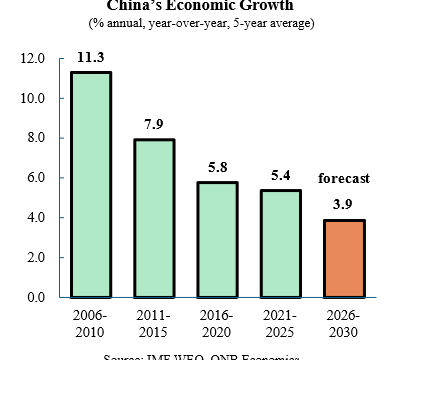
The 15th FYP is aligned with China’s long-term ambition of doubling per capita GDP from 2020 levels by 2035. By targeting a doubling of per capita GDP from 2020 levels by 2035, Beijing is implicitly committing to an average annual growth rate of approximately 4%. This implies a natural moderation in the rate of growth, as the country shifts to a more mature phase of economic development. This article summarises the key priorities of the new FYP.
The plan identifies five interconnected priorities. First, building a modern industrial system through manufacturing upgrading and advanced technology development. Second, driving domestic consumption as the primary engine of demand, replacing the investment and export-led model of previous decades. Third, accelerating the green transition through carbon intensity targets and a new National Low-Carbon Transition Fund. Fourth, strengthening social policy — employment,
childcare, education, and pension coverage — as a direct contributor to productive capacity. Fifth, deepening openness to foreign investment in strategic sectors, while pursuing a reduced dependence on US dollar-dominated financial systems through renminbi internationalisation and the development of an independent cross-border payment system.
Taken together, these priorities reflect a development model that is simultaneously more balanced and more self-reliant, than any previous FYP.
qnb-27042026.png
Media Folder :
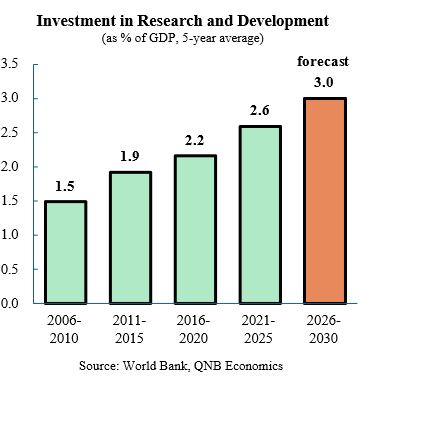
At the core of the 15th FYP’s industrial strategy lies a fundamental guidance: digital economy value- added growth, with some estimates suggesting levels of 12.5% of GDP by 2030. Beijing is no longer counting how many chips are produced, but measuring how deeply computing infrastructure, artificial intelligence (AI), and digital platforms penetrate the broader economy. A flagship “AI Plus” programme aims to embed artificial intelligence across industries as a productivity driver. Beyond semiconductors, the plan targets breakthroughs in biotechnology, quantum computing, advanced materials, aerospace, and 6G communications. Traditional industries — metals, machinery, and textiles — are to be upgraded through automation and digitalisation rather than replaced. This reflects a maturing policy approach of building an economy that produces and integrates advanced technology.
A key priority of the 15th FYP is its emphasis on household consumption as a driver of domestic demand. While investment, infrastructure, and exports remain important pillars of the Chinese economy, the plan places greater weight on expanding the role of private consumption in sustaining growth. Concretely, this means expanding childcare support to reduce the financial burden on young families, broadening pension coverage to give older households the confidence to spend rather than save, and improving employment conditions to support income growth across the working-age population. Reducing the savings rate is central to this strategy and redirects resources toward sectors that boost domestic demand.
qnb-27042026-2.png
Media Folder :
The 15th FYP embeds the green transition as a tangible commitment. The plan outlines targets such as a reduction in carbon intensity of around 17% by 2030 and an increase in the share of non-fossil energy to approximately 25% of total consumption. This marks a significant shift in policy language from controlling energy consumption to controlling carbon emissions directly. To finance this transition, Beijing has introduced a National Low-Carbon Transition Fund, structured under a government-led, market-operated model, designed to mobilise both public and private capital toward decarbonisation. China’s dominance in green technology manufacturing from solar panels, wind turbines to electric vehicles and batteries is treated in the plan not merely as a climate achievement but as a strategic industrial asset.
In summary, the 15th FYP aims to double per capita GDP by 2035. This however can only be achieved by further increases in productivity gains. China will need to deliver on technological upgrading, deeper digitalisation, and a more consumption-oriented economy.
Themes :
Les articles associés
-
 90
90 -
 35
35 -
144
-
54